Early Vision & The Beginning of the Program (1978–1993)
First helitank
The department anticipates receiving its first aircraft and forms a Helitack Crew. Ultimately, the aircraft does not materialize, but the team’s passion for aerial firefighting endures.
Late 1980s and early 1990s
proposal
The department prepares a comprehensive proposal to establish a firefighting helicopter program.
1994
evergreen
OCFD enters its first helicopter service contract with Evergreen Helicopters, Inc. The arrangement includes pilots, maintenance technicians, and a 900-gallon fuel truck and driver. That same year, the department responds to its first incident on June 22, 1994, marking the beginning of its air operations legacy.
FEPP
Around this time, OCFD also acquires three UH-1H helicopters through the Federal Excess Property Program (FEPP) — former U.S. Army aircraft from the Vietnam era that had been repurposed for local government — with a goal to refurbish two of these aircraft into “Super Hueys.”
1995
The Orange County Fire Authority Makes its Debut (1995–1997)
The Evergreen contract ends, and the department puts Copter 341 into full service. Around this time, OCFD transitions to the Orange County Fire Authority (OCFA) and relocates air operations to Fullerton Airport, leasing a 10,000-square-foot hangar and hiring its first in-house helicopter maintenance staff.
1996
Copter 41
OCFA begins operating its first refurbished Super Huey, designated Copter 41, followed by Copter 241 in 1997. The agency’s early fleet also included fuel tenders Helitender 41 and Helitender 241, both obtained through the FEPP program.
1999
Expansion and Modernization of Air Ops (1999–2025)
rescue hoist
OCFA purchases its first rescue hoist, beginning development of an all-risk helicopter rescue capability.
2005
goggles
Night Vision Goggle technology is introduced, enabling safe nighttime operations and marking a major leap forward in aerial firefighting.
2008
bell 412ep
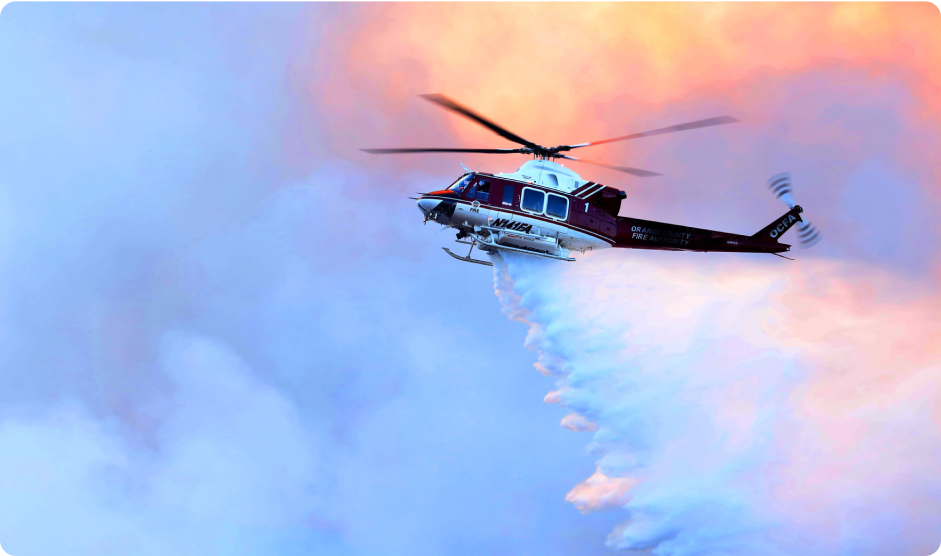
OCFA adds two new Bell 412EP twin-engine helicopters, branded as Copter 1 and Copter 2, supplementing the two existing Super Hueys (renamed Copters 3 and 4).
2012
22k sqft hangar
Air Operations moves into a state-of-the-art 22,000-square-foot hangar at Fullerton Airport, featuring three bays, a training room, and modern amenities.
2016
staffed
Each aircraft becomes staffed 24 hours a day with a Pilot, Crew Chief, and Helicopter Paramedic Rescuer, establishing true around-the-clock, all-risk response capability.
2017
chief pilot
Agency establishes Chief Pilot position.
2018
Agency adds second aircraft, staffing with a Pilot and Crew Chief 10 hours a day to assist with fire suppression and surge capacity.
2019
aircraft tech
Agency adds two Aircraft Technician positions, increasing technician staff to four.
FIRIS
OCFA Fire Chief Brian Fennessy creates the Fire Integrated Real-Time Intelligence System (FIRIS) in partnership with General Atomics, Courtney Aviation, UCSD, LAFD, Cal OES, and others. FIRIS is immediately successful, giving ground crews and the public real-time intelligence, growth models, and reconnaissance data on wildfires and other major disasters.
2020
Retires super huey
The agency retires the two Super Huey aircraft out of service.
OCFA Fire Chief Brian Fennessy establishes a public/private partnership with Southern California Edison, LACoFD, and VCFD, creating the Quick Reaction Force (QRF), which ultimately adds three CH-47 Helitankers and a Sikorsky 76 command and control aircraft to the fleet of the three fire agencies.
2022
The FIREHAWK Era (2022–Present)
FIREHAWK
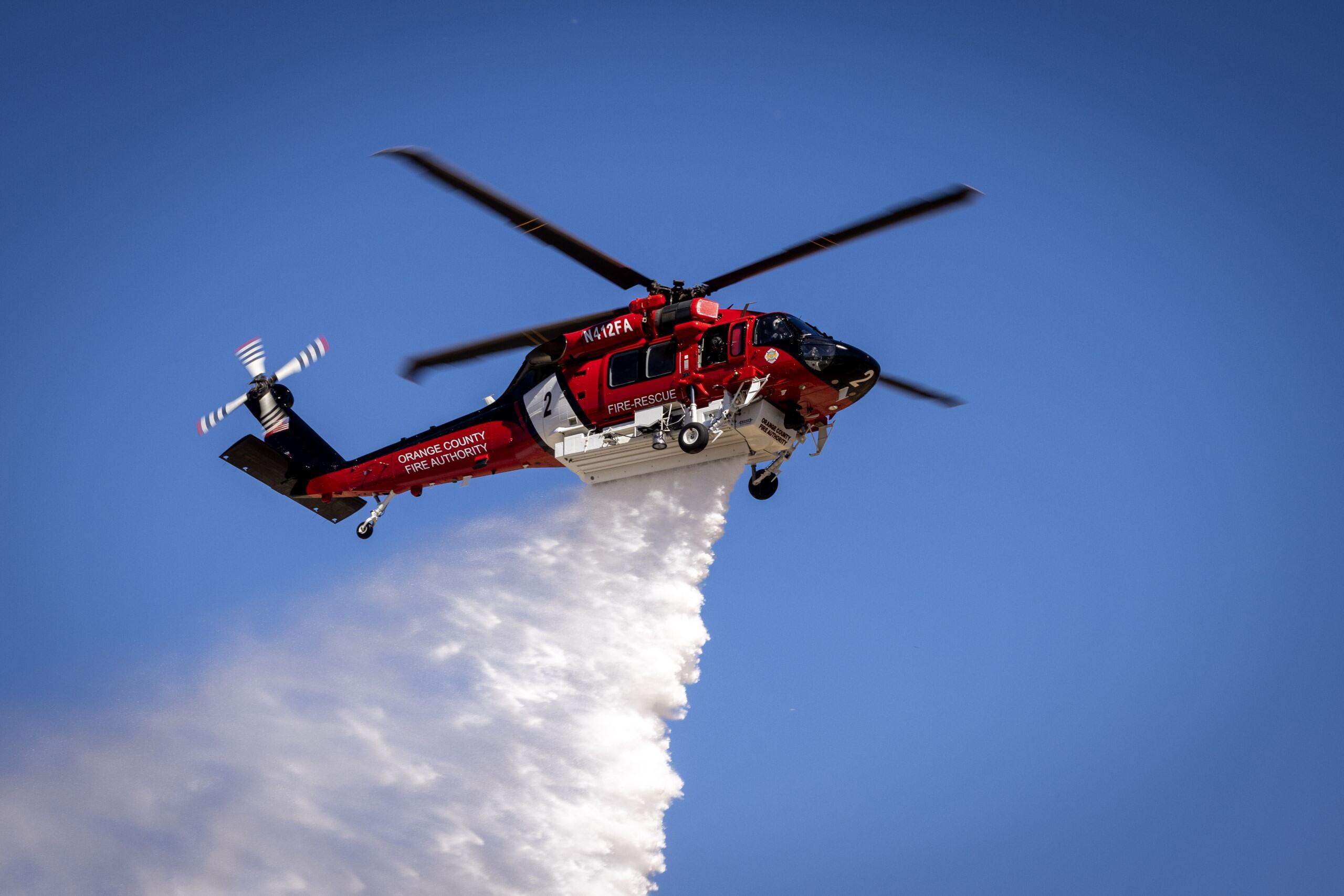
The OCFA Board of Directors approves the purchase of two Sikorsky S70 FIREHAWK helicopters, replacing the aging 1966 UH-1H “Super Hueys” that were grounded in 2020.
2024
The FIREHAWKS join OCFA’s two Bell 412EP helicopters, restoring a four-aircraft fleet to the OCFA for the first time in four years.
Agency expands primary aircraft to include an additional Helicopter Paramedic Rescuer (total of four personnel) and transitions the second aircraft to 24-hour staffing with three personnel – Crew Chief, Pilot, and Helicopter Paramedic Rescuer.